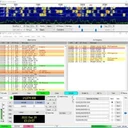
Aquí hi ha 5 versions de WSJT-X, des de 23 de febrer del 2025 fins a l’actual, 3.0.2. Cadascuna enllaça amb els instal·ladors del mateix desenvolupador.
5 versions en 1 any · unes 3,7 per any
| Versió | Data | Mida | Fitxers |
|---|---|---|---|
| 3.0.2Darrera versió | 19 de juny del 2026 | — | 64 bits EXE (NSIS) Notes de la versióWSJT-X 3.0.2 is a bug-fix release. New installation packages for
Windows, Linux, and macOS systems include user applications WSJT-X,
MAP65, and QMAP.
Changes since release 3.0.1:
- Ham Radio Deluxe (HRD): fixes CAT-control failures reported with
the 3.0.1 Windows builds, where WSJT-X could fail to communicate
correctly with HRD. HRD reply handling has been made more robust
while preserving compatibility with existing HRD responses.
- OmniRig: fixes setups where WSJT-X could fail to set the rig
frequency at startup on slower rigs, including reports involving
the FTDX-101 family.
- Transceiver Control Interface (TCI): fixes silent transmit audio
for modes with transmit/receive periods other than 15 s, improves
mode-change handling, and corrects split/fake-split frequency state
updates.
- MAP65 and QMAP: MAP65 is again included in the release packages.
MAP65 includes cross-platform modernization work, improved decoder
output and audio/device handling, and fixes for JT65 live decoding
and transmit audio. MAP65 and QMAP also now use writable user
locations for settings and generated runtime files in packaged
installs.
- Wide Graph: "Erase reference spectrum" now properly clears stale
reference-spectrum correction so it no longer affects new waterfall
data.
- Callsign highlighting: highlighted callsigns can now be cleared
reliably, and background highlighting is correctly applied to the
second callsign on a decode line.
- Audible Alerts: Wanted alert sounds on Linux and macOS now follow
the Wanted alert setting rather than the DX Call alert setting.
- WAV files: improves WAV/BWF file handling so malformed or truncated
recordings are handled robustly and no longer risk crashing WSJT-X.
- CloudLog: sends a versioned User-Agent with API-key tests and QSO
uploads, fixing failures on hosting providers that reject requests
without a User-Agent header.
- Windows: the installer now detects when WSJT-X is already running
and asks you to close it before upgrading, avoiding incomplete
installs caused by locked files.
- Windows: fixes clean installs where features depending on Transport
Layer Security (TLS) could fail. This bug could affect features
such as SuperFox verification, Update Hamlib, LoTW user-data
download, eQSL, and other HTTPS downloads/uploads, such as spotting
to LiveCQ.
- macOS: fixes packages that could miss required data files on fresh
installs, restoring FT8 callsign filtering, DXCC country names,
grid-to-state lookup, and astronomical-data lookup.
- macOS: Intel packages are now built with a macOS 10.13 deployment
target and checked to avoid bundled package-manager runtime
libraries built for newer macOS versions, improving compatibility
with older Intel Macs.
- Linux: fixes .deb installs on systems that already have
distribution packages for wsjtx-data, wsjtx-doc, or
wsjtx-improved-*, avoiding file conflicts and improper removal of
dependent packages such as JS8Call.
- Release builds: downloadable installers are now produced by an
automated build-and-package pipeline for Windows, macOS, and
Linux. This improves release consistency and catches
packaging/runtime problems before publication. |
| 3.0.1 | 3 de maig del 2026 | — | 64 bits EXE (NSIS) Notes de la versióWSJT-X 3.0.1 is a bug-fix release; installation packages include QMAP
but not MAP65. Code has the following changes since release 3.0.0:
- In posts sent to PSKReporter, version 3.0.0 incorrectly identified
itself as "WSJT-X v3.0.0 i+". Corrected.
- Uploads to CloudLog are re-enabled.
- UI Compatibility mode is enabled for better display on macOS Tahoe.
- A bug sometimes affecting CW transmissions in Echo mode has been
fixed.
- A bug preventing callsign highlighting in some circumstances has
been fixed.
- Corrected band limits for the 2.5 mm and 2 mm bands.
- Correct faulty repositioning of SWR label in status bar, after a
mode switch.
- Fix stale Band Activity decodes after enabling SuperFox while in
Hound mode (reported by AF8C). |
| 3.0.0 | 5 d’abril del 2026 | — | 64 bits EXE (NSIS)32 bits EXE (NSIS) Notes de la versióWSJT-X 3.0.0 introduces a number of new features and capabilities,
many of which are already familiar to users of Release Candidate
WSJT-X 3.0.0-rc1. Among the more important enhancements since version
2.7.0 are the following:
- Single-click Band Buttons, enabled from the View menu.
- FT8 Decoding option for parallel processing in concurrent threads,
and other changes that yield improved decoding speed and
performance.
- Optional filters to suppress display of various categories of
decoded messages.
- Options to Wait and Reply, Wait and Call, and Wait and Pounce.
- Audible Alerts to play a sound alerting you to reception of a
message with specified content.
- Transmitted Power and SWR can be displayed (as reported by the
radio) in a Status Bar label. Transmission can be stopped
automatically if SWR exceeds 2.5. These features work with most
modern radios controlled via Hamlib or FLRig.
- Band Hopping checkboxes for FT8, FT4 and MSK144 can activate
sequential reception intervals on the main sub-bands, or on up to
eight specified dial frequencies.
- High Resolution Monitors are supported with better scaling of fonts
and widget sizes.
- "Highlight orange" and "Highlight blue" features on the File |
Settings | Colors tab can now be used to highlight directional
calls (DX, SOTA, POTA, YOTA, etc.).
- MSK144 operation: "73" messages addressed to MyCall are now also
displayed in the right pane. A blank line is inserted between
decodes for different TR periods.
- Moon ephemeris charts can be downloaded from the Help menu.
- New EME Features include easier ways to select dial frequencies
within an EME sub-band and to offset your Tx frequency by an
integer number of MHz from the Rx frequency. New buttons are
provided for quick access to Echo mode and six popular Q65
sub-modes.
- Echo mode allows you to transmit your callsign (or any other
6-character group) to the Moon and decode its echo.
- QMAP and MAP65 offer spotting to the CQLive and PSKReporter web
sites and improved handling of compound callsigns. |
| 2.7.0 | 15 de febrer del 2025 | — | 64 bits EXE (NSIS)32 bits EXE (NSIS) Notes de la versióWSJT-X 2.7.0 is a General Availability (GA) release, the first since
version 2.6.1. Major enhancements include a new companion program
QMAP, new Special Operating Activities "Q65 Pileup" and "SuperFox", a
new "Message System" feature, an option to update Hamlib at the click
of a button, and various other improvements.
- QMAP is of particular interest to those engaged in Earth-Moon-Earth
(EME) communication. It provides single-polarization receive-only
capabilities for any one of the 60-second submodes of Q65 and the
associated 30-second submode with the same tone spacing. It lets
you monitor all corresponding traffic in a 90 kHz sub-band while
conducting EME QSOs in the usual way with WSJT-X.
- Q65 Pileup mode helps DX operators using Q65 in circumstances with
many simultaneous callers and very weak signals, such as those
experienced by 6-meter EME DXpeditions.
- SuperFox mode behaves operationally like the old-style Fox and Hounds
mode but uses a new constant envelope waveform for Fox’s transmissions.
Messages can be transmitted simultaneously to as many as 9 Hounds with
no signal-strength penalty, resulting in a system gain of about +10 dB
compared to the older Fox-and-Hound operation using 5 slots.
- The new Message System allows structured plain text messages to be
sent to your QSO partner to request QSY to another band or mode, or
to send any one of a number of canned messages. This feature can be
especially useful during contests.
- A button labeled "Update Hamlib" lets you download and install the
latest version of the rig-control features in Hamlib.
- The cty.dat file can now be updated by clicking a single button.
Numerous other enhancements and bug fixes make operation smoother and
more intuitive. Features for main-window switching between modes have
been enhanced so that submode and status of the Sh and Fast checkboxes
are saved and restored by mode. Note that the "Update Hamlib" feature
is currently available only in Windows. |
| 2.6.1 | 23 de febrer del 2025 | — | 64 bits EXE (NSIS)32 bits EXE (NSIS) |